Wednesday, June 3, 2015

May 30 - Cliffs of Moher and Killarney

This morning we headed out of Galway to go to Killarney with several stops along the way.  We were passing through an area referred to as the Burren.  It is a series of barren limestone mountains that arre totally devoid of vegetation.  Here is an example of one of these hills.


Between. the barren hills there are bogs that the locals use for grazing cattle and sheep.  Here is an example of a thatched farm house with the barren hills in the background.


Here is a photo of the small town of Ballyvaghan sitting on a very picturesque bay.


And lots of sheep grazing the fields.


Here we have arrived at the Cliffs of Moher.  Here is the entrance to the visitors center.  It's built into the hillside.


And here are the cliffs.  They range in height from 390 to 700 feet high and are really spectacular.


Here is an observation tower that was built in 1835


Here is another photo.  The cliffs in the area are some of the tallest.  There are several walking paths that you can take along the cliff tops.  The rock that the cliffs are made of is relatively soft and so the cliffs are being eroded.  In the area we were it looks like the cliffs have moved back about 10 to 20 feet from where they were 100 years ago.


This is a nice looking pub that is very well know in this area.


Nice looking houses.


The remains of something.  Don't know what it was.


This is a memorial to the potato famine.  It shows a 4 year old boy named Michael Rice who has just lost both his parents and he is trying to get into the workhouse.  If he doesn't, he will starve.


A tower castle we passed.  They are fairly common as any clan that wanted to show their wealth, built one.


Here is a more impressive castle.


We are now in the city of Limerick.  This is the location where the Irish Catholic forces surrendered to William of Orange's forces ending the war that had started at the Battle of the Boyne in 1690.  This rock is where the treaty was signed and was originally in the center of a bridge crossing the River Shannon.


This is King John's castle just across the river.


We've been seeing lots of swans.


We passed this cute thatched cottage.


We arrived at Killarney and checked into our hotel.  This evening we are going out to an Irish music and dance demonstration on the Muckross Plantation.  Muckross was a mansion and farm just outside of Killarney.  It was built in 1843 an given to Ireland in 1932  and became the first national park in the country.  It is dedicated to preserving the Irish way of life.  When we first arrived we entered the old schoolroom and our host gave us a lecture on what it was like in the old days.


We then went into another room for dinner and were entertained by these musicians.  The flutist in the center had previously won the all Ireland competition as a flutist.


We then were entertained by these two young dancers who put on a great show.


Tomorrow we will be driving around the Ring of Kerry.

May 29 - Connemara Peninsula and Galway

This morning we drove out of town to explore the Connemara Peninsula to the west of Galway.  This is a large area that is mostly sheep and cattle ranching but it is also famous for its marble quarries.  Lots of mountainous terrain, bogs and fields with scattered farm houses as you see in these photos.


Here you can see a farm with the fields behind surrounded by rock walls.


Some very nice looking houses.


And the rock walls go right up the sides of the hills.


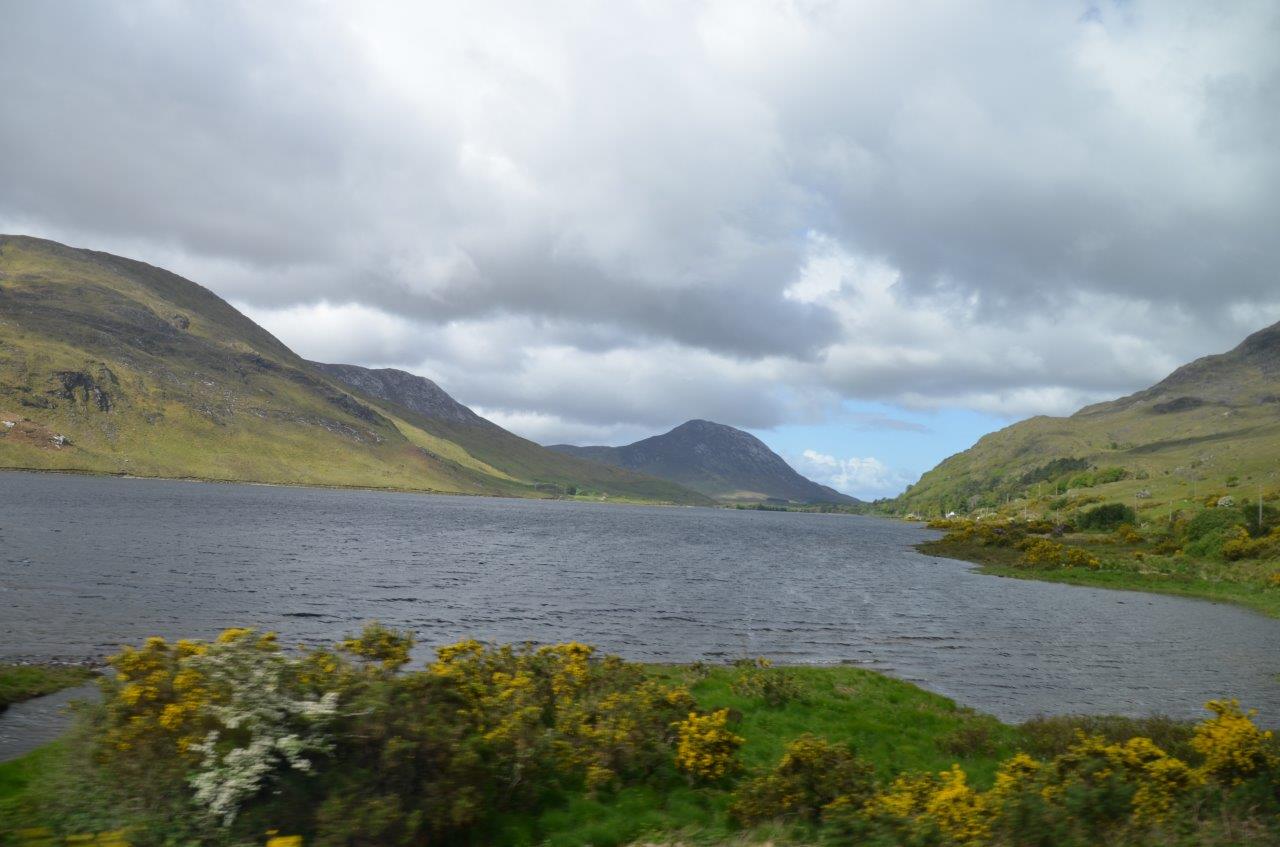
We stopped for coffee at this fjord.  It's one of three in Ireland and separates County Galway from County Mayo.  It was formed by the glaciers which once covered Ireland and is 10 miles long and 150 feet deep.


Another example of the mountainous terrain


One of the primary sources of heat in the early days and still very popular is peat, what the Irish refer to as sod.  Here you can see where a local farmer has been cutting the sod.  The peat is many feet thick and has been built up over many thousands of years.


Lots of lakes.  Beautiful but very barren.


One of the attractions in this area is Kylemore Abbey and here is a photo of it.


This abbey was originally built in 1867 by a wealthy London doctor who wanted it as a romantic castle for his wife and family in a quiet and beautiful location..That he got in spades as you can see here.


He and his family lived here for a number of years until his wife died while on a trip to Egypt.  At that point the castle had too many sad memories so he returned to London.  Eventually it was sold to the Benedictine Nuns in 1920 who had been forced to flee Ypres, Belgium, due to WW I.  Here is the entrance to the abbey.


And an example of one of the rooms in the abbey.


The original castle Victorian gardens have been restored and here are some photos I took as we walked through the gardens.


Here is the Tea Room where we had lunch.


High above the abbey is this shrine that had been built by the nuns.


We left the abbey and continued our travels through the peninsula.  Came across this pretty little waterfall to the side of the road.  Those are wild rhododendrons in the foreground.  They were all over the place.


Another example of an isolated farm house.


Here is another example of sod cutting.  They first scrape of the top growing layer and then use shovels and knives to cut the sod into small sections that they then stack to dry.  A number of the shops had stacks of firewood and sod for sale for use in home fireplaces.


Another example of a beautiful lake.


Connemara is famous for its marble quarries and here are some examples of the colors it comes in.


And of course the gift shop.  Pat bought a bracelet in sterling silver with inlaid pieces of marble in all of the colors that they quarry.  They used to supply their marble for building construction but the supply has got so limited that they only use it for jewelry now.


We've finally arrived back in Galway and here is a view of Galway bay with the Aran islands on the horizon.


Here we are walking through the streets of Galway.  This is the old section which dates back to 12th century.


What we found in the center of town was this former castle, now a bank, that had been built by the Lynch family in 1320.  My paternal grandmother was a Lynch but who knows if we are descended from this Lynch family or not.  Lynches were very important in Galway with James Lynch serving as the first mayor in 1484 and some 84 descendants held that position over the years.  The Lynches were Norman and were part of the Norman invasion of Ireland starting in 1169.  The Lynches originally lived in the town of Trim in County Meath but then later were part of the Norman force who conquered Galway in the 1230s.


After viewing the castle we went around the corner to the Church of St. Nicholas.  This church was built in the late 13th century and was known to have been in use in 1320.  Local lore is that Christopher Columbus visited this church prior to his visit to the new world and heard stories from the locals of what were thought to be Chinese sailors that had arrived during storms.  It is now believed that they might have been Inuit from Greenland.  Here is a photo of the church.


Here is a view of the main altar area.


And a close up of the stained glass window.


Here is the north Transept.


Here is the Nave of the church


The south Transept is known as the Lynch Transept and here is a tomb marker set into the wall.


For those having trouble reading the inscription, here is a translation.


Here is the Lynch coat of arms carved into a burial alcove.


This in one of two angels that had been carved into the alcove.  It was defaced in 1652 by Cromwell's troops when they used the church as a stable for their horses.


Another Lynch tomb.


And here is the tomb of James Lynch who died in 1644.  Being used today as a stage for readings and recitals.


Tomorrow we leave Galway and head to Killarney.